
Medically reviewed by Eduardo Garrido Goico, MD, FAAP
Board-Certified Pediatrician and Co-Founder, Ages & Stages Pediatric Group
Originally published: September 9, 2019
Last medically reviewed: July 29, 2026
Ear infections are one of the most common reasons parents bring babies and young children to the pediatrician.
A child with an ear infection may cry, pull at an ear, develop a fever, sleep poorly or suddenly seem more irritable than usual. Older children may clearly report ear pain, pressure or difficulty hearing. In babies and toddlers, however, the signs can be much less obvious.
Many childhood ear infections develop during or shortly after a cold. Some require antibiotics, while selected mild infections may improve with pain relief and careful observation for approximately 48–72 hours.
An examination is important because ear pain can have several causes, and symptoms alone cannot confirm that a child has a middle-ear infection.
What Is a Middle-Ear Infection?
A middle-ear infection is called acute otitis media, often abbreviated as AOM.
The middle ear is the air-filled space behind the eardrum. It connects to the back of the nose and throat through a narrow passage called the eustachian tube.
When a child has a cold, nasal congestion or another respiratory infection, the eustachian tube can become swollen or blocked. Fluid may collect behind the eardrum. Viruses or bacteria may then grow in that fluid and cause inflammation, pressure and pain.
Children develop middle-ear infections more frequently than adults because their eustachian tubes are shorter, narrower and more horizontal. This makes it more difficult for fluid to drain.
What Are the Symptoms of an Ear Infection?
Ear infection symptoms can vary depending on the child’s age.
Possible symptoms include:
- Ear pain
- Pulling, rubbing or tugging at an ear
- Fussiness or unusual irritability
- Difficulty sleeping
- Fever
- Reduced appetite
- Crying or pulling away during feeding
- Difficulty hearing or responding to quiet sounds
- A feeling of pressure or fullness in the ear
- Balance problems
- Fluid or pus draining from the ear
Ear infections commonly occur with cold symptoms such as nasal congestion, a runny nose, coughing or a sore throat.
Ear pulling by itself does not necessarily mean that a baby has an infection. Babies may touch their ears when they are tired, teething or simply exploring their bodies.
How Can I Tell Whether My Baby Has an Ear Infection?
Babies cannot explain where they hurt, so parents often notice changes in behavior.
A baby with an ear infection may:
- Become unusually fussy
- Cry more when lying down
- Wake more frequently
- Feed less effectively
- Pull away during breastfeeding or bottle-feeding
- Develop a fever
- Seem less responsive to sounds
- Have drainage from the ear
Swallowing can sometimes increase pressure in the middle ear, making feeding uncomfortable.
Contact your pediatrician when a baby appears to have significant ear pain, fever, feeding difficulty, drainage from the ear or a notable change in behavior.
Is Every Earache an Ear Infection?
No. Ear pain can have several causes.
Other possibilities include:
- Fluid behind the eardrum without an active infection
- Swimmer’s ear, which affects the ear canal
- Earwax blocking the canal
- A foreign object in the ear
- An irritated or injured ear canal
- Throat or tonsil infections
- Dental pain
- Jaw pain
- Pressure changes during air travel
Because these conditions may require different treatment, it is important to have the ear examined rather than assuming that every earache requires an antibiotic.
What Is the Difference Between an Ear Infection and Fluid Behind the Eardrum?
An active middle-ear infection causes inflammation and symptoms such as ear pain, fever or irritability.
Fluid can also remain behind the eardrum after the infection itself has resolved. This is called otitis media with effusion.
Middle-ear fluid does not mean that an active infection is still present. A child may feel well but temporarily have muffled hearing, ear pressure or a sensation that the ear is blocked.
Antibiotics should not be prescribed simply to make persistent middle-ear fluid disappear. The fluid often clears gradually without treatment, although it may remain for several weeks.
Temporary hearing loss caused by middle-ear fluid is common and usually resolves without permanent damage. Persistent fluid may require follow-up, especially if hearing, speech, language, development or learning appears affected.
How Is an Ear Infection Diagnosed?
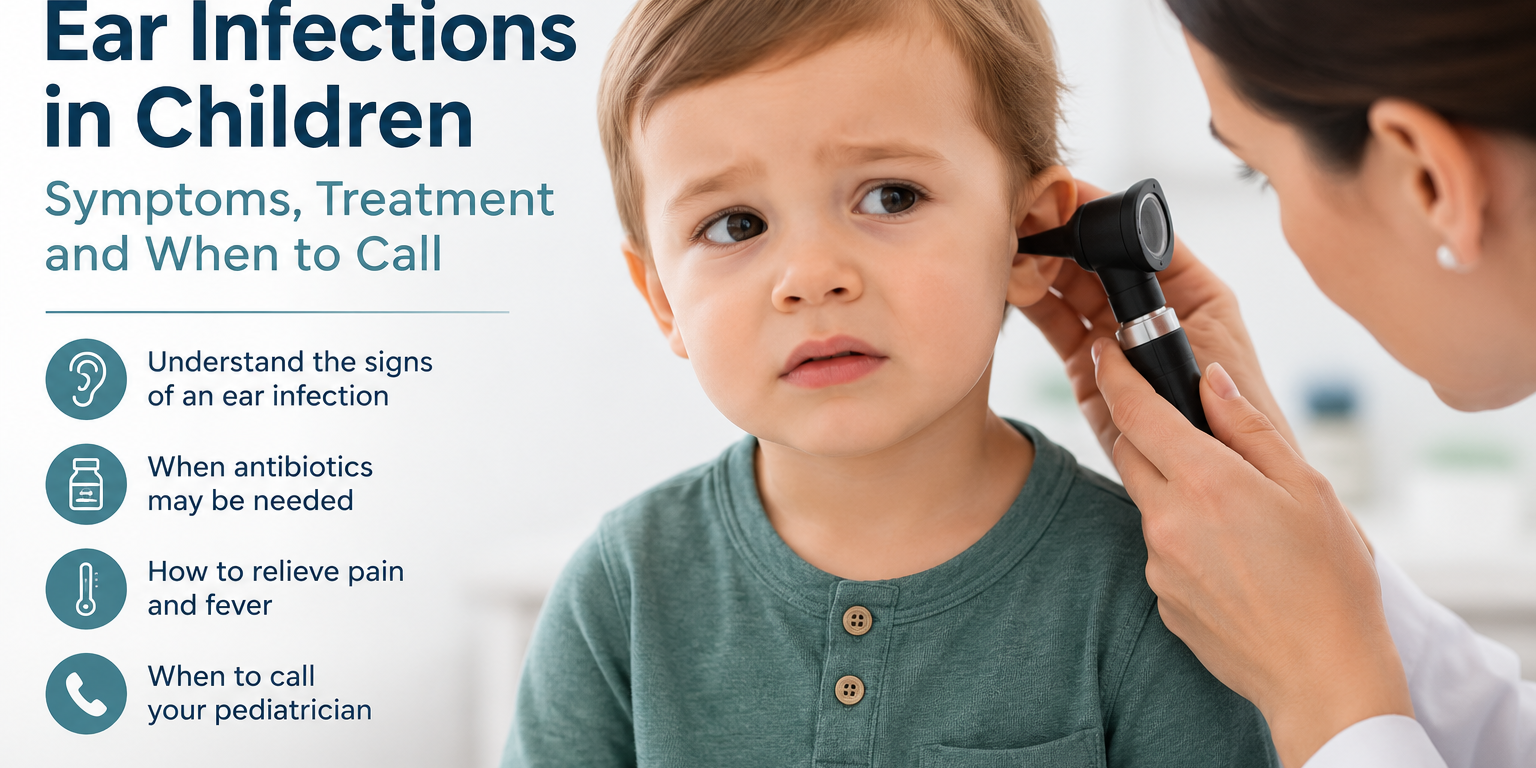
The pediatrician will ask about the child’s symptoms and examine the ear using a lighted instrument called an otoscope.
The examination may look for:
- A bulging or inflamed eardrum
- Fluid behind the eardrum
- Reduced movement of the eardrum
- Drainage
- A perforation or opening in the eardrum
- Swelling or irritation of the ear canal
- Earwax or another obstruction
A red eardrum alone does not always confirm acute otitis media. Crying, fever and irritation can also make the eardrum appear red. The pediatrician considers the complete examination and the child’s symptoms before making the diagnosis.
Do All Ear Infections Need Antibiotics?
No. Some middle-ear infections improve without antibiotics.
For selected children with mild acute otitis media, the pediatrician may recommend watchful waiting for approximately 48–72 hours. During this period, parents treat pain and fever, monitor symptoms closely and contact the office if the child worsens or does not begin improving.
Watchful waiting is not the same as ignoring the infection. It is a planned approach used when the child is likely to recover safely without immediate antibiotic treatment.
The decision depends on factors such as:
- The child’s age
- Whether one or both ears are affected
- The severity and duration of the pain
- The child’s temperature
- Whether fluid is draining from the ear
- The child’s medical history
- The certainty of the diagnosis
- The ability to obtain reliable follow-up care
Which Children Usually Need Immediate Antibiotic Treatment?
Immediate antibiotic treatment is generally recommended for:
- Children younger than 6 months
- Children with severe ear pain
- Children whose ear pain has lasted 48 hours or longer
- Children with a temperature of 102.2°F, or 39°C, or higher
- Children with fluid or pus draining from the ear
- Children younger than 2 years with infections in both ears
- Children with significant underlying medical conditions
- Children for whom reliable follow-up cannot be assured
The pediatrician will make a treatment recommendation based on the child’s age, symptoms, examination findings and medical history.
What Does Watchful Waiting Involve?
When observation is appropriate, parents may be advised to:
- Give pain or fever medicine as directed
- Encourage fluids
- Allow the child to rest
- Monitor the child’s temperature
- Watch for worsening pain or new symptoms
- Contact the office if symptoms do not begin improving within 48–72 hours
- Begin an antibiotic only if instructed by the healthcare provider
Some families may receive a delayed prescription with instructions explaining when it should be filled. Others may be asked to contact the office for reassessment.
Which Antibiotics Are Used for Ear Infections?
Amoxicillin is generally the first-line antibiotic for uncomplicated acute otitis media when the child does not have a relevant allergy or another reason to choose a different medication.
Amoxicillin-clavulanate or another antibiotic may be considered when:
- The child has taken amoxicillin during the previous 30 days
- The child has concurrent purulent conjunctivitis, or thick eye drainage
- The medical history suggests bacteria that may not respond adequately to amoxicillin alone
- The infection has not improved with initial amoxicillin treatment
- The child has a medication allergy
- Another medication is more appropriate based on the child’s history or examination
The exact medication, dose and length of treatment depend on the child’s age, weight, symptoms, severity and medical history.
Give the medication according to the prescribing clinician’s instructions. Do not stop early, share antibiotics or save unfinished medication for a future illness.
How Can I Help With Ear Pain?
Pain control is important whether or not the child receives an antibiotic.
Depending on the child’s age and medical history, the pediatrician may recommend:
- Acetaminophen
- Ibuprofen
Follow the dosing instructions provided by the child’s healthcare professional or the medication label. Medication doses for children are often based on weight.
Do not give aspirin to a child unless a physician specifically instructs you to do so.
Comfort measures may include:
- Holding and comforting the child
- Encouraging fluids
- Allowing extra rest
- Applying a warm—not hot—washcloth to the outside of the ear
What Should I Avoid Putting in My Child’s Ear?
Do not place anything into your child’s ear unless directed by a healthcare professional.
Avoid:
- Cotton swabs
- Hydrogen peroxide
- Oils
- Breast milk
- Herbal remedies
- Leftover antibiotics
- Leftover prescription ear drops
- Over-the-counter ear drops unless specifically recommended
Some ear drops should not be used when the eardrum has a perforation or when ear tubes are present. Over-the-counter ear drops should only be used when a healthcare professional recommends them and the eardrum is known to be intact.
How Quickly Should My Child Improve?
Most children begin to feel better within 24–48 hours, even though middle-ear fluid may remain for several weeks.
- Ear pain lasts longer than 48 hours
- Symptoms are worsening
- Fever persists or returns
- The child develops drainage from the ear
- The child is not improving within 48–72 hours
- The child cannot keep medication or fluids down
- You are concerned that the child’s hearing has worsened
- New swelling develops behind the ear
- You are concerned about the child’s overall condition
A child taking an antibiotic may need to be reexamined if symptoms do not improve as expected.
Does Ear Drainage Mean the Eardrum Has Ruptured?
Drainage may occur when pressure behind the eardrum causes a small opening or perforation.
Parents may notice yellow, white, cloudy or blood-tinged fluid coming from the ear. Sometimes the child’s pain decreases after drainage begins because the pressure has been relieved.
The child should still be evaluated. The pediatrician can examine the eardrum, determine whether treatment is needed and arrange follow-up to make sure the opening heals.
Do not place cotton swabs or other objects inside the ear canal.
What Are Recurrent Ear Infections?
Some children experience repeated episodes of acute otitis media.
Recurrent ear infections are generally defined as:
- Three infections within six months, or
- Four infections within twelve months
The pattern should be discussed with the pediatrician. The doctor may review:
- Whether each episode was a confirmed middle-ear infection
- How frequently infections occur
- Whether fluid remains between infections
- Whether hearing appears affected
- Speech and language development
- Daycare exposure
- Tobacco-smoke exposure
- Other medical or developmental factors
Some children with recurrent infections may benefit from evaluation by an ear, nose and throat specialist.
When Are Hearing Testing or an ENT Referral Considered?
Hearing testing or referral to an ear, nose and throat specialist may be considered when:
- Middle-ear fluid persists for approximately three months
- Parents or caregivers are concerned that hearing has worsened
- The child has delayed speech or language development
- There are developmental concerns
- There are learning or school concerns
- The child has recurrent confirmed ear infections
- The diagnosis or treatment plan requires additional evaluation
The pediatrician will consider the child’s age, medical history, examination findings, hearing and developmental needs.
When Are Ear Tubes Considered?
Ear tubes are tiny cylinders placed through the eardrum by an ear, nose and throat specialist. They allow air to enter the middle ear and fluid to drain.
Ear tubes are not automatically recommended for every child who has several ear infections.
They may be considered when a child has:
- Recurrent confirmed ear infections
- Middle-ear fluid at the time of the ENT evaluation
- Fluid that persists for several months
- Hearing difficulties
- Speech or language concerns
- Developmental or learning concerns
- Other factors that increase the effect of reduced hearing
The presence or absence of middle-ear fluid during the specialist evaluation can affect whether tubes are recommended.
The decision is individualized. The ENT specialist considers the child’s infection history, ear examination, hearing and developmental needs before recommending surgery.
Can Ear Infections Affect Hearing or Speech?
Fluid behind the eardrum can temporarily reduce hearing. Sounds may seem muffled or distant.
Temporary hearing loss caused by middle-ear fluid is common and usually resolves without permanent damage as the fluid clears.
Persistent or repeated hearing difficulty, however, can affect how a child hears speech and participates at home, childcare or school.
Contact the pediatrician if your child:
- Does not respond consistently to sounds
- Frequently asks people to repeat themselves
- Turns the television volume unusually high
- Appears inattentive in noisy environments
- Has delayed or unclear speech
- Has developmental concerns
- Has school or learning difficulties
- Has middle-ear fluid that does not resolve
The pediatrician may recommend follow-up examinations, formal hearing testing or referral to an ENT specialist.
What Causes Repeated Ear Infections?
Several factors can increase a child’s likelihood of developing ear infections, including:
- Young age
- Frequent colds
- Attending group childcare
- Exposure to tobacco smoke or vaping aerosols
- A family history of frequent ear infections
- Craniofacial differences
- Certain medical or developmental conditions
- Feeding while lying completely flat
- Prolonged pacifier use
Having one or more risk factors does not mean that a child will definitely develop recurrent infections.
Can Ear Infections Be Prevented?
Not every ear infection can be prevented, but families can reduce some risks.
Helpful steps may include:
- Keeping the home and car free from tobacco smoke and vaping aerosols
- Keeping routine childhood vaccinations current
- Getting the annual influenza vaccine
- Receiving pneumococcal vaccination according to the routine immunization schedule
- Encouraging regular handwashing
- Reducing exposure to respiratory illnesses when practical
- Breastfeeding when possible
- Holding babies in a more upright position during bottle-feeding
- Avoiding bottle propping
- Discussing prolonged pacifier use with the pediatrician
Parents should not feel blamed when a child develops an ear infection. Ear infections are extremely common, particularly during the first few years of life.
Do Swimming and Bath Water Cause Middle-Ear Infections?
No. Swimming and bath water do not cause acute otitis media when the eardrum is intact.
Typical middle-ear infections develop behind the eardrum and are usually related to congestion, respiratory infections and poor drainage through the eustachian tube.
Water trapped in the outer ear canal can contribute to swimmer’s ear, which is a different condition.
Children with ear tubes, a perforated eardrum or recent ear surgery may receive specific water precautions from their pediatrician or ENT specialist.
Can My Child Go to School or Daycare With an Ear Infection?
An ear infection itself is not contagious. However, the cold or respiratory infection that preceded it may be contagious.
Whether a child should stay home depends on:
- Fever
- Pain
- Energy level
- Ability to participate
- Vomiting or other symptoms
- The school or daycare illness policy
A child who has a fever, significant pain or cannot participate comfortably should remain home.
The pediatrician can provide a school or daycare note when medically appropriate.
When Should I Call the Pediatrician?
Contact your child’s pediatrician when:
- Ear pain lasts longer than 48 hours
- A baby or young child has unexplained fever or irritability
- Symptoms are worsening
- Fever persists or returns
- Fluid, pus or blood drains from the ear
- Your child is not improving within 48–72 hours
- Your child is feeding poorly
- Your child has repeated ear infections
- You are concerned that hearing has worsened
- Speech or language development appears delayed
- Middle-ear fluid persists
- New swelling develops behind the ear
- Your child develops new symptoms during treatment
Children younger than 3 months with a rectal temperature of 100.4°F or higher require prompt medical evaluation.
When Is an Ear Problem an Emergency?
Seek urgent or emergency medical care if your child has:
- Severe swelling, redness or tenderness behind the ear
- An ear that begins protruding outward
- Severe or rapidly worsening pain
- Facial weakness
- Severe headache
- A stiff neck
- Confusion
- Unusual drowsiness or difficulty waking
- Trouble walking or severe balance problems
- Repeated vomiting with serious illness
- A seizure
- Blue or gray coloring
- Difficulty breathing
- Unresponsiveness
These symptoms may raise concern for serious complications such as mastoiditis or spread of infection beyond the middle ear.
Call 911 for a life-threatening emergency.
Frequently Asked Questions About Ear Infections
Is an ear infection contagious?
No. A middle-ear infection itself cannot be passed from one person to another.
However, the cold or respiratory infection that contributed to it may be contagious.
Does teething cause ear infections?
Teething does not directly cause a middle-ear infection.
Teething discomfort can make a baby fussy and may cause ear rubbing, which can sometimes be mistaken for an infection.
Can my child have an ear infection without a fever?
Yes. Some children have ear pain, irritability, sleep problems or hearing changes without developing a fever.
Does every red eardrum mean an infection?
No. Crying, fever and irritation can make an eardrum appear red.
The pediatrician also looks for signs such as bulging, middle-ear fluid and reduced movement of the eardrum.
Can I clean inside my child’s ear with a cotton swab?
No. Cotton swabs can push wax deeper, irritate the canal or injure the eardrum.
Clean only the outside of the ear with a soft cloth unless a healthcare professional gives different instructions.
Can I use peroxide or oil in my child’s ear?
No. Do not place peroxide, oils, breast milk, herbal remedies or other substances into the ear unless specifically directed by a healthcare professional.
Can I use leftover antibiotics?
No. Leftover antibiotics may be the wrong medication, dose or treatment duration for the current illness.
Your child should be examined and receive a new prescription when antibiotics are medically appropriate.
Can I use over-the-counter ear drops?
Do not use ear drops unless a healthcare professional confirms that the product is appropriate and the eardrum is intact.
Some drops should not be used when the eardrum has a perforation or when ear tubes are present.
Can an ear infection cause permanent hearing loss?
Temporary muffled hearing is common when fluid is present and usually resolves without permanent damage.
Persistent fluid, repeated infections or ongoing hearing concerns require follow-up.
Will my child need ear tubes?
Most children with an occasional ear infection do not need tubes.
Tubes may be considered when infections are recurrent, fluid persists, hearing is affected or developmental concerns are present. They are not automatically recommended for every child with repeated infections.
Pediatric Ear Infection Care in Pineville and Gastonia
Ages & Stages Pediatric Group evaluates and treats ear pain, middle-ear infections, recurring infections and persistent middle-ear fluid at both our Pineville and Gastonia pediatric offices.
Our pediatric team can help with:
- Ear examinations
- Diagnosis of acute otitis media
- Pain and fever guidance
- Watchful waiting when appropriate
- Antibiotic treatment when needed
- Follow-up after an ear infection
- Evaluation of persistent middle-ear fluid
- Recurrent ear infection management
- Hearing, speech and developmental concerns
- School or daycare documentation
- Referrals for hearing testing or ENT care when needed
Contact Ages & Stages Pediatric Group if your child has ear pain, fever, drainage, hearing changes or repeated ear infections.
About the Medical Reviewer
Eduardo Garrido Goico, MD, FAAP, is a board-certified pediatrician and co-founder of Ages & Stages Pediatric Group. He provides preventive, developmental, behavioral and general pediatric care for infants, children and adolescents.
Medical Disclaimer
This article is intended for general educational purposes only. It does not replace diagnosis, treatment or individualized medical advice from your child’s healthcare provider.
Contact a qualified healthcare professional if you have concerns about your child’s ear pain, fever, hearing or other symptoms. Seek emergency care for severe swelling behind the ear, facial weakness, confusion, unresponsiveness or another life-threatening symptom.
“`