
Medically reviewed by Eduardo Garrido Goico, MD, FAAP
Board-Certified Pediatrician and Co-Founder, Ages & Stages Pediatric Group
Originally published: July 10, 2019
Last medically reviewed: July 29, 2026
Few questions matter more to exhausted new parents than, “When will my baby finally sleep through the night?”
The honest answer is that every baby develops a little differently. Newborns wake frequently because they need to eat, their sleep cycles are still developing, and they have not yet learned the difference between day and night. Although many babies begin sleeping for longer stretches during the first several months, waking during the night remains normal throughout infancy.
Newborns may sleep approximately 16 to 17 hours during a 24-hour period, but often only for one or two hours at a time. More predictable sleep cycles generally begin developing around 4 months of age.
Rather than focusing on a particular date when your baby “should” sleep all night, it is more helpful to understand what is developmentally appropriate, practice safe sleep habits and gradually establish routines that support healthy sleep.
What Does “Sleeping Through the Night” Actually Mean?
Parents sometimes assume that sleeping through the night means a baby sleeps continuously for eight to twelve hours.
In discussions of infant sleep, however, the phrase may refer to a shorter stretch—often approximately six to eight hours—without needing to be fed or comforted.
Babies and adults both move through multiple sleep cycles each night. Brief awakenings between cycles are normal. A baby who appears to sleep through the night may still wake briefly but settle back to sleep without fully alerting the household.
The ability to sleep for longer periods depends on several factors, including:
- The baby’s age and developmental stage
- Whether the baby was born full-term or prematurely
- Feeding needs and weight gain
- Temperament
- Sleep environment
- Medical conditions
- The baby’s ability to settle after briefly waking
There is no single sleep schedule that applies to every healthy infant.
How Newborn Sleep Is Different
Newborn sleep can feel unpredictable. A newborn may sleep much of the day but wake frequently around the clock.
During the first weeks of life, babies often wake because they need to feed. Their stomachs are small, and regular feeding is important for hydration, nutrition and appropriate weight gain.
Newborns also have not developed a mature circadian rhythm—the internal process that helps the body distinguish daytime from nighttime. As a result, a newborn may have a long period of alertness at night and sleep more soundly during the day.
This pattern does not mean that the parents have created a bad habit or that something is wrong. It is usually part of normal early development.
When Do Babies Begin Sleeping Longer?
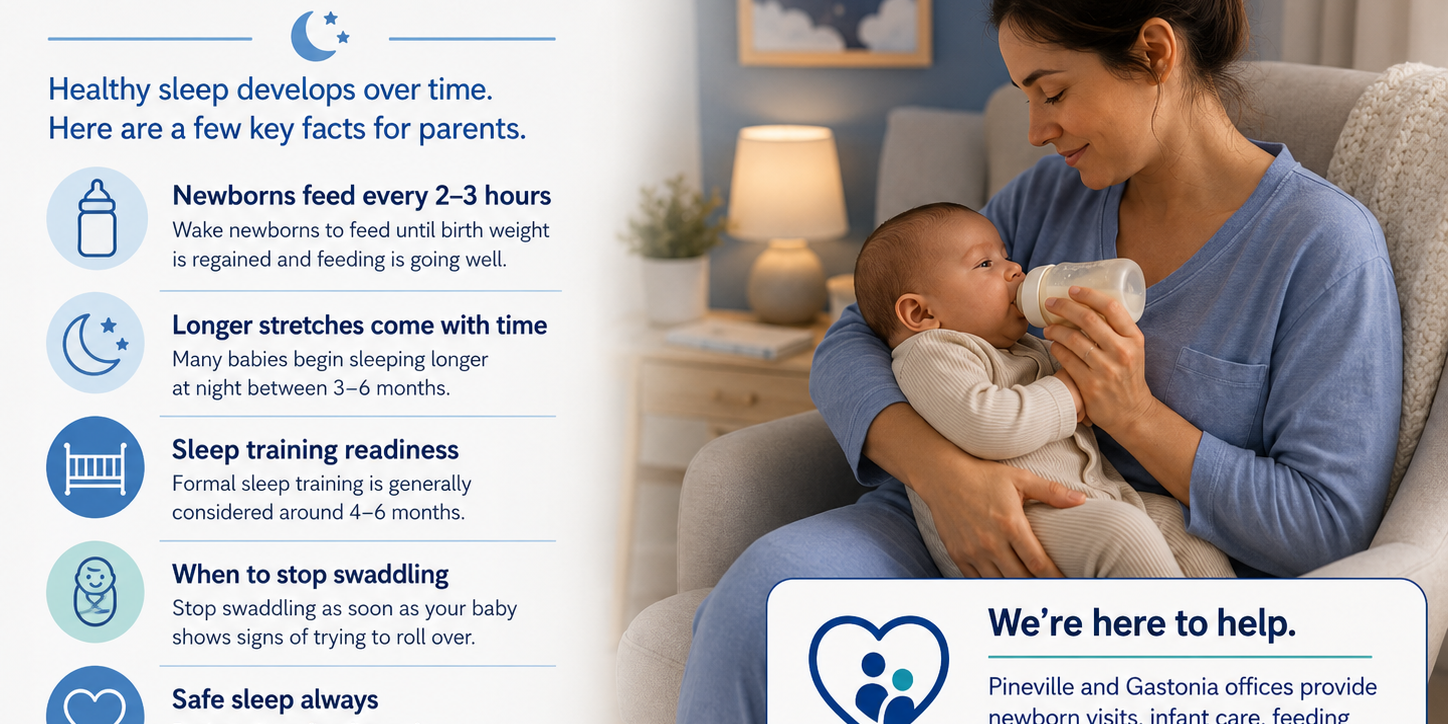
Some babies begin sleeping for longer nighttime stretches between 3 and 6 months of age. By around 4 months, sleep cycles often become more organized, although nighttime waking may continue.
Other babies take longer, particularly if they:
- Were born prematurely
- Need additional nighttime feedings
- Are experiencing a growth spurt
- Are teething
- Have reflux or another medical concern
- Are learning a new developmental skill
- Have recently experienced a change in routine
- Need more help settling between sleep cycles
Premature babies may take longer to develop extended nighttime sleep. Some full-term babies may sleep six to eight hours at night by around 4 months, while premature babies may not reach that stage until 6 to 8 months or later.
Even a baby who has been sleeping well may begin waking again. Infant sleep often changes during periods of rapid physical and developmental growth.
Should I Wake My Newborn to Feed?
During the newborn period, we generally recommend waking babies every 2 to 3 hours to feed until they have regained their birth weight and are feeding and growing well.
A baby may need to be awakened more consistently for feeding if the baby:
- Has not regained birth weight
- Was born prematurely
- Has jaundice
- Is having difficulty feeding
- Is not producing enough wet diapers
- Has a medical condition affecting growth or nutrition
After the baby has regained their birth weight and is feeding and growing appropriately, feeding recommendations are individualized based on the baby’s growth, health and medical needs.
Parents should follow the feeding guidance provided for their individual baby rather than assuming that the baby is ready to skip nighttime feedings.
Do Breastfed and Formula-Fed Newborns Feed Differently?
Breastfed newborns often feed more frequently than formula-fed newborns. However, feeding recommendations should always be based on the baby’s weight gain, feeding effectiveness, hydration and overall health rather than feeding method alone.
Some babies may need to feed more often regardless of whether they receive breast milk, formula or a combination of both.
Contact your pediatrician if your baby:
- Is difficult to wake for feedings
- Feeds fewer times than recommended
- Has difficulty latching or sucking
- Does not appear satisfied after feeding
- Has fewer wet diapers than expected
- Is not gaining weight appropriately
How Can I Help My Baby Learn the Difference Between Day and Night?
Newborns do not immediately understand that nighttime is for longer sleep. Parents can gently reinforce the difference between daytime and nighttime.
During the day:
- Open the curtains and allow normal household light
- Talk, sing and interact with the baby
- Provide supervised awake time and age-appropriate tummy time
- Avoid keeping the entire home completely quiet during naps
- Feed according to the baby’s needs
At night:
- Keep lights low
- Speak softly
- Avoid unnecessary stimulation
- Keep feeding and diaper changes calm
- Return the baby to the sleep space once care is complete
This does not produce an instant schedule, but consistency can gradually help the baby’s developing internal clock.
Establishing a Simple Bedtime Routine
A predictable routine can signal that it is time to settle down.
The routine does not need to be complicated. Depending on the baby’s age, it might include:
- Feeding
- A clean diaper
- Pajamas or a sleep garment
- A short book or quiet song
- Dimming the lights
- Placing the baby in the crib or bassinet
Try to follow the same general sequence each evening. A routine is often more useful than enforcing an exact bedtime, especially during the early months when feeding and sleep needs can change quickly.
As babies grow older, bedtime can gradually become more consistent.
Should I Put My Baby Down Awake?
Parents often hear that they should put a baby in the crib “drowsy but awake.”
This approach may help some babies gradually become accustomed to falling asleep in their own sleep space. However, it does not work perfectly every time, particularly with newborns.
Young babies commonly fall asleep while feeding, rocking or being held. Parents do not need to feel that they have failed if their newborn requires assistance settling.
As the baby grows, parents can occasionally try placing the baby down when calm and sleepy but not completely asleep. Over time, this may help the baby practice settling independently.
What Is a Sleep Regression?
The phrase “sleep regression” is commonly used when a baby who had been sleeping for longer stretches suddenly begins waking more frequently.
These periods often coincide with developmental changes, including:
- Rolling
- Sitting
- Crawling
- Pulling to stand
- Increased awareness of caregivers
- Changes in nap schedules
- Teething
- Illness
- Separation anxiety
The change may last for several days or weeks. Maintaining a calm and consistent routine can help while the baby adjusts.
However, not every sleep disruption should be assumed to be developmental. Contact the pediatrician if the baby seems ill, is feeding poorly, has breathing difficulties or has another concerning symptom.
Safe Sleep Is More Important Than Sleeping Longer
Parents may become so exhausted that almost any method promising additional sleep sounds appealing. However, the safest sleep environment should always take priority over how long the baby sleeps.
For every nap and nighttime sleep:
- Place the baby on their back
- Use a firm, flat sleep surface
- Use a safety-approved crib, bassinet or play yard
- Cover the mattress only with a fitted sheet
- Keep pillows, blankets, bumper pads and stuffed toys out of the sleep area
- Keep the baby’s sleep space in the parents’ room, but use a separate surface
- Avoid couches, recliners and adult beds as infant sleep surfaces
- Avoid inclined sleepers and positioners
Room sharing without bed sharing is recommended for at least the first 6 months. The baby should remain on a separate, firm and flat sleep surface.
What Should My Baby Wear for Sleep?
Dress your baby in clothing appropriate for the room temperature.
We recommend a properly fitted, non-weighted sleep sack or wearable blanket that meets current safety standards.
Avoid:
- Weighted sleep sacks
- Weighted swaddles
- Weighted blankets
- Loose blankets
- Oversized sleep garments
- Products that can cover the baby’s face
Make sure the baby does not become overheated. Signs of overheating may include sweating, damp hair, flushed skin, a hot chest or rapid breathing.
When Should I Stop Swaddling?
Stop swaddling as soon as your baby shows signs of attempting to roll over.
Do not wait until the baby is consistently rolling. Early signs may include rocking from side to side, twisting the body or repeatedly trying to turn onto the side.
At that point, transition to a properly fitted, non-weighted sleep sack or wearable blanket and continue placing your baby on their back for every sleep.
A swaddled baby who rolls onto their stomach may have difficulty repositioning their body or lifting their head.
What If My Baby Has Reflux?
Babies with reflux should still generally be placed flat on their backs to sleep unless their physician provides a different medically necessary instruction.
Elevating the mattress or placing the baby in an inclined sleeper is not recommended. Inclined products can allow a baby’s position to shift in a way that interferes with breathing.
Parents should speak with their pediatrician if reflux is associated with:
- Poor weight gain
- Feeding refusal
- Frequent choking or coughing
- Blood in vomit
- Green vomit
- Forceful vomiting
- Significant pain or distress
- Breathing difficulties
Will Cereal or Solid Food Help My Baby Sleep Longer?
Starting cereal or other solid foods early is not a recommended strategy for helping a baby sleep through the night.
Starting solid foods before approximately 6 months does not reliably help babies sleep through the night.
A baby should begin solid foods based on developmental readiness and guidance from the pediatrician—not as a sleep treatment.
Parents should also avoid putting cereal into a bottle unless a healthcare professional has specifically recommended it for a medical reason.
Should I Use a Bottle in the Crib?
A baby should not be placed in the crib with a bottle.
Allowing a baby to fall asleep with a bottle can expose developing teeth to milk or other liquids for an extended period. It can also create feeding and safety concerns.
Feed and burp the baby as needed, then remove the bottle before placing the baby in the sleep space.
When Is Sleep Training Appropriate?
Sleep training refers to a variety of approaches intended to help a baby fall asleep and return to sleep with less assistance.
Formal sleep training is generally considered around 4 to 6 months of age, once a baby is developing appropriately, gaining weight well and no longer requires routine nighttime feedings.
Every baby is different, and readiness should be discussed individually with each family.
Formal sleep-training approaches are generally not intended for newborns. During the newborn period, responding to feeding and comfort needs remains important.
Before beginning sleep training, parents should discuss it with the pediatrician, particularly when the baby:
- Was born prematurely
- Has had difficulty gaining weight
- Still requires overnight feeding
- Has reflux or another medical condition
- Has breathing concerns
- Is younger than the age recommended for the chosen approach
There is no single sleep-training method that is right for every family. A pediatrician can help determine whether the baby is developmentally and medically ready and discuss an approach that is appropriate for the family.
When Should I Call the Pediatrician About My Baby’s Sleep?
Contact your pediatrician if your baby:
- Is unusually difficult to wake
- Is feeding poorly
- Is not gaining weight appropriately
- Has fewer wet diapers than expected
- Has noisy or difficult breathing
- Regularly snores or pauses while breathing
- Turns blue, gray or very pale
- Has repeated choking episodes
- Has a fever, especially during early infancy
- Is extremely irritable or difficult to console
- Suddenly develops a significant change in sleep behavior
- Cannot lie flat without apparent breathing difficulty
- Frequently vomits forcefully
Seek emergency medical assistance for serious breathing difficulty, blue or gray coloring, unresponsiveness or another life-threatening symptom.
Frequently Asked Questions About Infant Sleep
Is it normal for my newborn to wake every two hours?
Yes. Many newborns wake every one to three hours to feed. During the newborn period, babies are generally awakened every 2 to 3 hours until they have regained their birth weight and are feeding and growing well.
Why does my baby sleep well during the day but stay awake at night?
Newborns have not yet developed a mature day-night rhythm. Exposure to daylight, normal daytime activity and a quiet nighttime environment can gradually help.
Is my baby waking because my breast milk is not enough?
Frequent waking alone does not prove that breast milk supply is inadequate.
Signs such as appropriate weight gain, swallowing during feeds, feeding effectiveness and an adequate number of wet diapers provide more useful information. Speak with the pediatrician or a qualified lactation professional if you have feeding concerns.
Do formula-fed babies sleep through the night sooner?
Breastfed newborns often feed more frequently than formula-fed newborns, but feeding method does not determine when a baby will sleep through the night.
Sleep patterns should be evaluated based on the baby’s development, growth, feeding needs, temperament and overall health.
Should the house be silent during naps?
No. Babies can generally sleep with normal household noise. Keeping daytime naps completely dark and silent may make it harder to reinforce the distinction between day and night.
Can I let my baby sleep in a swing or car seat?
Car seats are designed for travel, and swings are designed for supervised awake use—not routine sleep.
When practical, move a sleeping baby to a firm, flat and approved infant sleep surface. The safest routine sleep position is flat on the back in an empty crib, bassinet or play yard.
Should I keep my baby awake during the day so they sleep at night?
No. Overtired babies may become more irritable and have greater difficulty settling.
Age-appropriate naps are an important part of infant sleep. Parents can encourage daytime alertness without preventing a tired baby from sleeping.
When should I stop swaddling?
Stop swaddling as soon as your baby shows signs of attempting to roll over. Transition to a properly fitted, non-weighted sleep sack and continue placing your baby on their back for every sleep.
When can my baby sleep with a blanket or pillow?
Soft bedding should be kept out of an infant’s sleep area. During the baby’s first year, use appropriate sleep clothing or a properly fitted, non-weighted wearable blanket instead of loose blankets.
Discuss the transition to toddler bedding with your pediatrician when your child is older and has moved beyond the infant sleep stage.
Infant Sleep Does Not Need to Be Perfect
Sleep is one of the most stressful parts of early parenthood. Parents may compare their baby with friends’ children or worry that frequent waking means they are doing something wrong.
In most cases, infant sleep develops gradually rather than according to a fixed deadline.
A baby may sleep for six hours one week and wake every two hours the next. Illness, teething, feeding needs, travel and developmental changes can all affect sleep.
Concentrate on three priorities:
- Meeting the baby’s feeding and medical needs
- Maintaining a safe sleep environment
- Building a simple and consistent routine
Longer stretches of sleep usually come with time.
Newborn and Infant Care in Pineville and Gastonia
Ages & Stages Pediatric Group provides newborn visits, infant well-child care, feeding support and guidance on healthy sleep habits at both our Pineville and Gastonia pediatric offices.
Our pediatric team can help parents with questions about:
- Feeding
- Breastfeeding and formula feeding
- Weight gain
- Safe sleep
- Sleep routines
- Sleep-training readiness
- Swaddling and sleep sacks
- Crying
- Reflux
- Development
- Immunizations
- Changes in sleep or behavior
Contact Ages & Stages Pediatric Group to schedule a newborn visit or infant well-child appointment, or to discuss concerns about your baby’s feeding, growth or sleep.
About the Medical Reviewer
Eduardo Garrido Goico, MD, FAAP, is a board-certified pediatrician and co-founder of Ages & Stages Pediatric Group. He provides preventive, developmental and general pediatric care for infants, children and adolescents.
Medical Disclaimer
This article is intended for general educational purposes only. It does not replace diagnosis, treatment or individualized medical advice from your child’s healthcare provider. Contact a qualified healthcare professional if you have concerns about your baby’s feeding, growth, breathing, development or sleep.
“`