Medically reviewed by Eduardo Garrido Goico, MD, FAAP
Board-Certified Pediatrician and Co-Founder, Ages & Stages Pediatric Group
Originally published: December 20, 2019
Last medically reviewed: July 29, 2026
Bringing a new baby home is exciting, but it can also make parents feel anxious—especially when it comes to sleep.
Babies spend many hours sleeping during their first year. Creating a safe sleep environment for every nap and every nighttime sleep is one of the most important steps parents and caregivers can take to reduce the risk of sudden infant death syndrome, commonly called SIDS, and other sleep-related infant deaths.
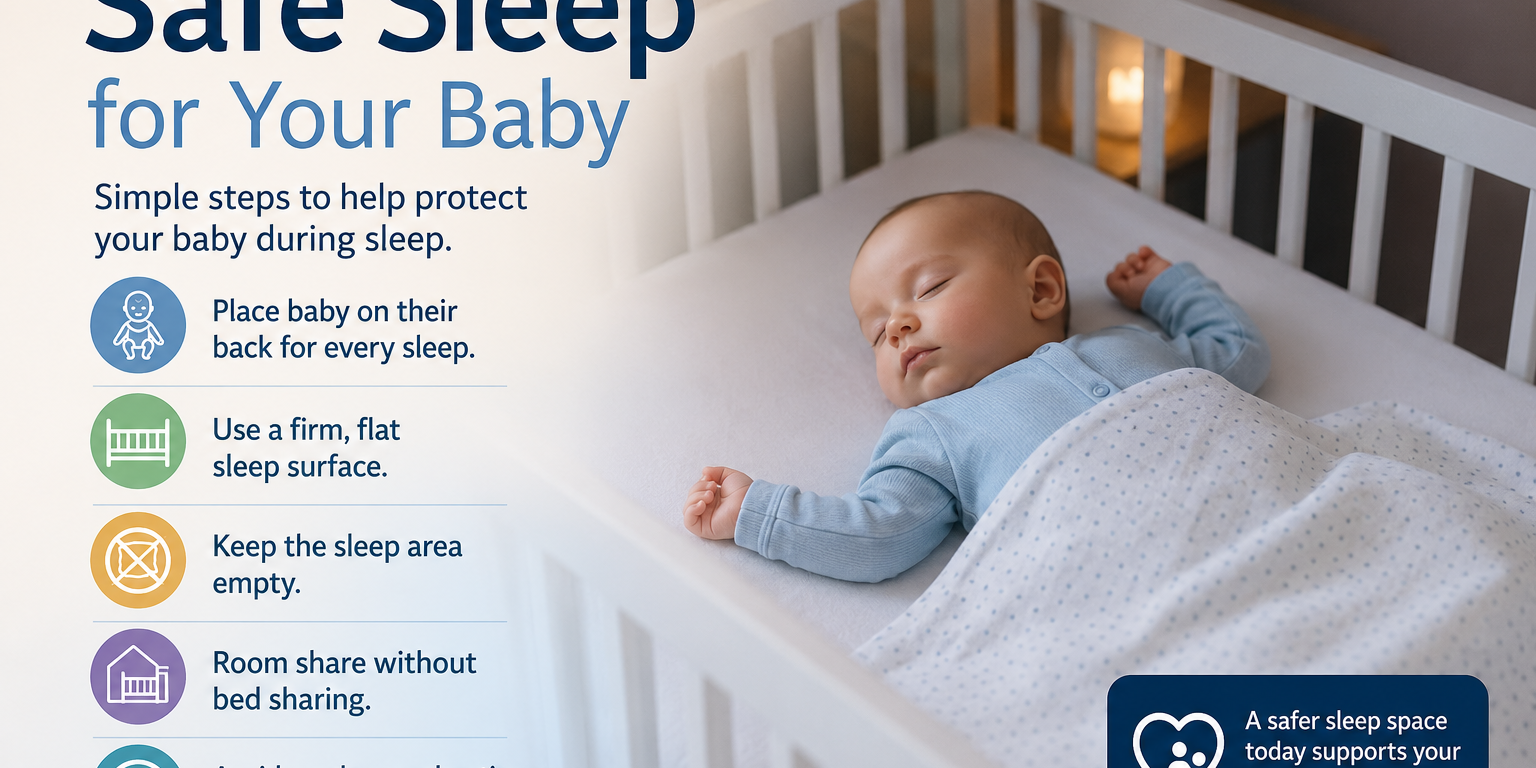
The safest approach is simple:
- Place your baby on their back for every sleep
- Use a firm, flat sleep surface
- Keep the sleep area empty
- Share a room without sharing a bed
- Avoid smoke, overheating and unsafe sleep products
These recommendations apply at home, while traveling and anywhere else your baby sleeps. Current guidance from the American Academy of Pediatrics, CDC and NIH emphasizes back sleeping on a firm, flat surface with no soft bedding or other objects in the sleep area.
What Is Safe Sleep?
Safe sleep means placing a baby in an environment designed to reduce the risk of suffocation, entrapment, strangulation, SIDS and other sleep-related deaths.
A safe infant sleep area should include:
- A safety-approved crib, bassinet, portable crib or play yard
- A firm, flat mattress designed for that specific product
- A tightly fitted sheet
- Nothing else in the sleep area
The baby should be placed flat on their back without pillows, loose blankets, stuffed animals, bumper pads, positioners or other soft items.
Safe sleep recommendations should be followed for every sleep, including short naps.
Always Place Your Baby on Their Back
Babies should be placed on their backs for every nap and every nighttime sleep until 1 year of age.
Side sleeping is not considered safe because babies can roll more easily from their side onto their stomach. Stomach sleeping increases the risk of SIDS and other sleep-related deaths.
Back sleeping is recommended even for babies who:
- Were born prematurely
- Have reflux
- Spit up frequently
- Seem to sleep more deeply on their stomach
- Have already begun rolling
The back position is the safest sleep position for babies, including infants born prematurely and most babies with reflux.
What If My Baby Spits Up?
Many parents worry that a baby placed on their back could choke if they spit up.
Healthy babies have protective airway reflexes that help prevent choking. Their anatomy also makes choking less likely while they are lying on their backs than many parents assume.
Most infants with reflux should still be placed flat on their backs to sleep. Elevating the mattress, placing objects beneath the mattress or using wedges and sleep positioners is not recommended.
If a baby has a medical condition that requires a different sleep position, that position should only be used under the direction of the baby’s physician.
Do not use an inclined sleeper. These products can cause a baby to slide into a position that interferes with breathing.
Contact your pediatrician if your baby has:
- Poor weight gain
- Feeding refusal
- Blood in vomit
- Green vomit
- Forceful vomiting
- Frequent choking
- Breathing difficulty
- Significant pain or distress with feeding
What If My Baby Rolls Over?
Parents should always place their baby on their back at the beginning of every sleep.
Once a baby can comfortably roll from back to stomach and from stomach to back without assistance, parents generally do not need to repeatedly turn the baby over during sleep.
However, the sleep area should remain empty and the mattress should remain firm and flat.
Do not use wedges, positioners or rolled blankets to prevent movement. Sleep positioners are not recommended because they can create suffocation or entrapment hazards.
Use a Firm, Flat Sleep Surface
A baby should sleep on a surface that is both firm and flat.
Safe options may include:
- A crib
- A bassinet
- A portable crib
- A play yard
The product should meet current federal safety standards and should be assembled and used according to the manufacturer’s instructions.
A firm mattress should not indent deeply when the baby lies on it. The mattress should fit the sleep product properly without dangerous gaps.
Avoid sleep surfaces that are:
- Soft
- Padded
- Angled
- Inclined
- Damaged
- Improvised
- Not intended for infant sleep
Adult beds, couches and armchairs are not safe infant sleep surfaces. Couches and armchairs are especially dangerous when an adult unintentionally falls asleep while feeding or comforting a baby.
Keep the Crib Empty
An infant’s sleep area should contain only:
- The baby
- A firm mattress
- A tightly fitted sheet
Do not place the following items in the crib or bassinet:
- Pillows
- Loose blankets
- Quilts
- Comforters
- Stuffed animals
- Crib bumpers
- Nursing pillows
- Sleep positioners
- Wedges
- Toys
- Sheepskins
- Loose sheets
- Weighted blankets
- Weighted swaddles
Soft objects and loose bedding can cover a baby’s face, restrict airflow or trap the baby against the side of the sleep area.
Even products marketed for infant sleep may be unsafe. Parents should not assume that an item is safe simply because it is sold in a baby store or included on a registry.
How Can I Keep My Baby Warm Without a Blanket?
Dress your baby in sleep clothing appropriate for the room temperature.
Safer options may include:
- Footed pajamas
- A wearable blanket
- A properly fitted, non-weighted sleep sack
In general, a baby may need approximately one more layer than an adult would wear comfortably in the same room.
Avoid overheating. Signs that a baby may be too warm include:
- Sweating
- Damp hair
- Flushed skin
- A hot chest
- Rapid breathing
The baby’s hands and feet may feel cool even when their body temperature is comfortable. Check the chest or back rather than judging warmth by the hands alone.
Do not use weighted blankets, weighted sleep sacks or weighted swaddles for an infant. The American Academy of Pediatrics and Consumer Product Safety Commission advise against weighted infant sleep products.
Room Sharing Without Bed Sharing
The safest arrangement is for the baby to sleep in the parents’ room on a separate sleep surface.
This means placing the crib, bassinet or play yard near the parents’ bed rather than placing the baby in the adult bed.
Room sharing:
- Makes nighttime feeding and comforting easier
- Allows parents to remain close to the baby
- Reduces the risk of SIDS and other sleep-related deaths compared with placing the baby in a separate room
Room sharing without bed sharing is recommended for at least the baby’s first 6 months.
Are Bedside Bassinets Safe?
Bedside bassinets or bedside sleepers that securely attach to the parents’ bed and meet current safety standards may be used according to the manufacturer’s instructions.
The baby should always remain on their own separate, firm and flat sleep surface. The baby should never sleep directly in the adult bed.
Make sure the bedside bassinet is correctly assembled, securely attached and free from gaps that could create an entrapment hazard.
Why Is Bed Sharing Risky?
Bed sharing means that a baby sleeps on the same surface as an adult, another child or a pet.
Adult beds are not designed for infant safety. Hazards may include:
- Soft mattresses
- Pillows and blankets
- Gaps between the mattress and wall
- Entrapment in a bed frame
- Accidental suffocation
- An adult or child rolling onto the baby
- The baby falling from the bed
The risk is especially high when:
- The baby is younger than 4 months
- The baby was born prematurely
- The baby had a low birth weight
- An adult smokes
- An adult has consumed alcohol
- An adult has used marijuana, sedatives or other impairing substances
- An adult is unusually tired
- The surface is a couch, recliner or armchair
The safest recommendation is to place the baby in a separate crib, bassinet, bedside bassinet or play yard near the caregiver’s bed.
What Should I Do During Nighttime Feedings?
Nighttime feeding can be challenging when parents are exhausted.
Before feeding your baby, consider how likely you are to fall asleep. Avoid feeding on a couch or armchair because these surfaces are particularly dangerous if the caregiver falls asleep.
Helpful precautions include:
- Turn on enough light to remain alert
- Set an alarm
- Ask another adult to stay nearby
- Avoid sedating medications, alcohol or other impairing substances
- Return the baby to the crib or bassinet when feeding is complete
If there is a possibility that you may fall asleep while feeding in bed, remove pillows, loose blankets and other soft items from the area before beginning. Move the baby back to their own sleep surface as soon as you awaken.
The American Academy of Pediatrics advises tired parents to plan ahead for nighttime feeding and to avoid couches and armchairs where unintentional sleep can be especially hazardous.
Can My Baby Sleep in a Car Seat?
Car seats are designed for travel, not routine sleep.
A baby who falls asleep while riding in a properly installed car seat does not need to be awakened immediately during travel. Once you reach your destination, move the baby to a firm, flat sleep surface as soon as practical.
Do not place a car seat on:
- A bed
- A couch
- A table
- A countertop
- Another elevated surface
The car seat may tip or fall, and a baby’s head position may interfere with breathing.
Swings, bouncers, loungers and infant seats should also not be used as routine sleep spaces.
Are Inclined Sleepers Safe?
No. Inclined infant sleepers are not recommended for sleep.
A baby can slide downward, turn into the side of the product or move into a position that restricts breathing.
The sleep surface should be flat rather than elevated or angled.
Parents should also avoid:
- Sleep wedges
- Positioning pillows
- In-bed sleepers
- Baby nests
- Loungers marketed for sleep
- Hammock-style sleep products
Use only products intended and approved for infant sleep.
What About Swaddling?
Swaddling may help some young infants feel calm, but it does not reduce the need to follow safe sleep recommendations.
Swaddling should only be used for young infants. A swaddled baby should always be placed on their back on a firm, flat sleep surface.
The swaddle should:
- Fit securely without covering the baby’s face
- Allow room for the hips and legs to move
- Be non-weighted
- Not cause overheating
Stop swaddling as soon as your baby shows signs of attempting to roll over. Do not wait until the baby is consistently rolling.
A swaddled baby who rolls onto their stomach may have difficulty repositioning their body or lifting their head.
Parents should also avoid swaddling so tightly that it restricts normal hip movement.
Can My Baby Use a Pacifier?
Offering a pacifier at nap time and bedtime may help reduce the risk of SIDS.
For breastfeeding infants, consider offering a pacifier after breastfeeding is well established.
Do not force the baby to use it. If the baby refuses the pacifier or it falls out after the baby falls asleep, there is no need to replace it.
Do not attach the pacifier to:
- Clothing while the baby is sleeping
- A stuffed animal
- A blanket
- A cord
- A clip with a long strap
These attachments can create strangulation or suffocation hazards.
Does Breastfeeding Affect SIDS Risk?
Breastfeeding and the use of human milk are associated with a lower risk of SIDS.
Any amount of human milk may be beneficial, and longer duration generally provides greater protection.
However, safe sleep recommendations remain important regardless of whether a baby is breastfed, formula-fed or receives a combination.
Parents should never feel blamed if breastfeeding is not possible or does not go as planned. A baby can still be placed in a safe sleep environment regardless of feeding method.
Keep Your Baby’s Environment Smoke-Free
Exposure to cigarette smoke during pregnancy or after birth increases the risk of SIDS and other health problems.
Do not allow smoking or vaping:
- Inside the home
- Inside the car
- Near the baby
- In the baby’s sleep area
Smoke residue can remain on clothing, furniture and other surfaces.
Families who need help quitting should speak with a healthcare provider about available support.
Are Home Heart and Breathing Monitors Recommended?
Consumer heart-rate and breathing monitors should not be used as a replacement for safe sleep practices.
These devices have not been shown to prevent SIDS in healthy babies. They may also produce false alarms or give parents a false sense of security.
A physician may prescribe medical monitoring for certain infants with specific health conditions. Parents should use such equipment according to the medical team’s instructions.
Even when a monitor is used, the baby should still sleep:
- On their back
- On a firm, flat surface
- In an empty sleep space
- Without bed sharing
Safe Sleep While Traveling
Safe sleep recommendations apply when visiting family, staying in a hotel or traveling overnight.
Before a trip:
- Confirm that a safe crib, bassinet or play yard will be available
- Bring a portable sleep space when necessary
- Check that the product has not been recalled
- Bring a correctly fitted sheet
- Avoid improvised sleeping arrangements
Do not place a baby to sleep in:
- A hotel bed
- A drawer
- A padded chair
- A couch
- An adult travel bed
- A nest or lounger
Everyone who cares for your baby should follow the same safe sleep rules.
Talk With Grandparents and Other Caregivers
Some caregivers may have used different sleep practices in the past.
Explain that current recommendations have changed as researchers have learned more about SIDS, suffocation and other sleep-related deaths.
Make sure that babysitters, relatives and childcare providers know to:
- Place the baby on their back
- Use a firm, flat surface
- Keep the crib empty
- Avoid bed sharing
- Stop swaddling when the baby shows signs of attempting to roll
- Avoid letting the baby sleep in a swing or lounger
Clear instructions are especially important when the baby regularly spends time in another home.
When Should I Call the Pediatrician?
Contact your pediatrician if your baby:
- Has noisy or difficult breathing
- Frequently snores
- Pauses while breathing
- Turns blue, gray or very pale
- Is difficult to wake
- Feeds poorly
- Is not gaining weight appropriately
- Chokes or coughs repeatedly during feeding
- Vomits forcefully
- Cannot lie flat without apparent breathing difficulty
- Has a sudden change in sleep or behavior
Call emergency services immediately if your baby is unresponsive, stops breathing, turns blue or has severe breathing difficulty.
Frequently Asked Questions About Safe Sleep
Can my baby sleep on their stomach if I am watching?
No. Babies should be placed on their backs for every sleep, including supervised naps.
Tummy time is important for development, but it should only occur while the baby is awake and being closely supervised.
Is side sleeping safe?
No. Side sleeping is unstable and makes it easier for a baby to roll onto their stomach.
Place the baby flat on their back instead.
What if my baby sleeps better on their stomach?
Some babies appear to sleep more deeply on their stomachs, but deeper sleep is not necessarily safer.
Continue placing your baby on their back for every sleep.
Can I elevate the crib mattress for reflux?
No. Elevating the mattress can cause a baby to slide or become trapped in an unsafe position.
Most babies with reflux should still sleep flat on their backs. A different sleep position should only be used when specifically directed by the baby’s physician.
Can I use a blanket tucked under the mattress?
Loose blankets and soft bedding should be kept out of the infant sleep area.
Use properly fitted sleep clothing or a non-weighted wearable blanket instead.
Can twins sleep in the same crib?
Each infant should have a separate sleep surface.
Placing twins or other multiple-birth infants together can increase the risk of overheating, entrapment and suffocation.
Is a bedside sleeper safe?
A bedside bassinet or bedside sleeper may be appropriate when it securely attaches to the parents’ bed, meets current safety standards and is used exactly as directed by the manufacturer.
The baby should remain on their own separate, firm and flat sleep surface and should never sleep directly in the adult bed.
When can a baby sleep with a pillow or blanket?
Soft objects and loose bedding should remain out of the sleep area throughout infancy.
Speak with your pediatrician when your child is older and transitioning from a crib to a toddler bed.
A Simple Safe Sleep Checklist
For every sleep, ask:
- Is my baby on their back?
- Is the surface firm and flat?
- Is the crib, bassinet or play yard safety-approved?
- Is the fitted sheet the only bedding?
- Is the sleep area empty?
- Is the baby sleeping separately from adults, children and pets?
- Is the baby comfortably dressed without overheating?
- Is the environment free of smoke and vaping?
If the answer to each question is yes, you have created a safer sleep environment.
Newborn and Infant Care in Pineville and Gastonia
Ages & Stages Pediatric Group provides newborn visits, well-child care and ongoing pediatric guidance for families in Pineville, Gastonia and surrounding communities.
Both our Pineville and Gastonia pediatric offices provide counseling and guidance on:
- Safe sleep
- Feeding
- Weight gain
- Reflux
- Swaddling
- Crying
- Newborn care
- Infant development
- Immunizations
- Infant sleep patterns
Contact Ages & Stages Pediatric Group to schedule a newborn visit or well-child appointment, or to discuss concerns about your baby’s sleep, feeding, development or breathing.
About the Medical Reviewer
Eduardo Garrido Goico, MD, FAAP, is a board-certified pediatrician and co-founder of Ages & Stages Pediatric Group. He provides preventive, developmental and general pediatric care for infants, children and adolescents.
Medical Disclaimer
This article is intended for general educational purposes only. It does not replace diagnosis, treatment or individualized medical advice from your child’s healthcare provider. Contact a qualified healthcare professional if you have concerns about your baby’s breathing, feeding, growth, development or sleep.
“`