Medically reviewed by Eduardo Garrido Goico, MD, FAAP
Board-Certified Pediatrician and Co-Founder, Ages & Stages Pediatric Group
Originally published: October 15, 2019
Last medically reviewed: July 29, 2026
Asthma is a chronic condition that affects the airways—the tubes that carry air in and out of the lungs.
In a child with asthma, the airways can become inflamed, narrowed and more sensitive than usual. When symptoms flare, the muscles surrounding the airways may tighten and mucus production may increase, making it harder for the child to breathe.
Common symptoms include coughing, wheezing, chest tightness and shortness of breath. Symptoms may be mild and occasional, or they may interfere with sleep, exercise, school and everyday activities.
Asthma cannot always be prevented, but it can usually be controlled with an individualized treatment plan, appropriate medication, correct inhaler or nebulizer technique and efforts to reduce exposure to known triggers.
What Are the Symptoms of Asthma in Children?
Asthma does not look exactly the same in every child.
Possible symptoms include:
- Frequent coughing
- Wheezing or a whistling sound while breathing
- Shortness of breath
- Chest tightness or discomfort
- Rapid breathing
- Difficulty keeping up during sports or active play
- Coughing during exercise
- Coughing or wheezing at night
- Waking from sleep because of breathing symptoms
- Longer recovery from colds or respiratory infections
- Repeated episodes diagnosed as bronchitis
- Fatigue or reduced activity because breathing feels difficult
Some children have obvious wheezing. Others mainly have a persistent cough, especially at night, during exercise or when they have a cold.
Young children may not be able to describe chest tightness or shortness of breath. Parents may instead notice that the child tires quickly, avoids active play, breathes faster than usual or says that their chest hurts or feels unusual.
What Is an Asthma Attack?
An asthma attack, sometimes called an asthma flare or exacerbation, occurs when symptoms become significantly worse.
During an attack:
- The airway lining becomes more inflamed
- The muscles around the airways tighten
- The airways become narrower
- Mucus may further restrict airflow
The child may cough repeatedly, wheeze, breathe quickly or struggle to take a full breath. Asthma attacks range from mild to life-threatening.
Prompt treatment according to the child’s written asthma action plan can often prevent symptoms from becoming more serious.
What Can Trigger Asthma Symptoms?
An asthma trigger is something that causes or worsens symptoms. Triggers differ from one child to another, and a child may have several.
Common triggers include:
- Viral respiratory infections
- Tobacco smoke
- Vaping aerosols
- Pollen
- Dust mites
- Mold
- Cockroaches
- Pet dander
- Air pollution
- Strong odors or cleaning products
- Smoke from fireplaces or wood-burning stoves
- Cold or rapidly changing weather
- Exercise
- Strong emotions or prolonged crying
- Stress
- Certain medications in some children
Respiratory infections are a particularly common trigger in children. A cold that causes only congestion in one child may lead to prolonged coughing, wheezing or difficulty breathing in a child with asthma.
Knowing a child’s triggers and reducing avoidable exposure can help lower the risk of asthma attacks, although it is not always possible or necessary to eliminate every potential trigger.
Does Exercise Cause Asthma?
Exercise does not cause asthma, but physical activity can trigger symptoms in some children.
A child may experience:
- Coughing during or after exercise
- Wheezing
- Chest tightness
- Shortness of breath
- Difficulty keeping up with other children
- A need to stop frequently
Children with well-controlled asthma should generally be able to participate in sports, physical education and active play.
Exercise-related symptoms may indicate that the asthma treatment plan needs to be adjusted. Some children are instructed to use a prescribed quick-relief medication before activity.
Parents should not routinely limit exercise without discussing the symptoms with the child’s healthcare provider.
How Is Asthma Diagnosed in Children?
There is no single test that diagnoses every case of childhood asthma.
The pediatrician may consider:
- The child’s symptoms
- How often symptoms occur
- When and where symptoms happen
- Family history of asthma or allergies
- Personal history of eczema or allergies
- Known triggers
- Previous emergency visits or hospitalizations
- Response to asthma medication
- Physical examination findings
- Lung-function testing, when age appropriate
Spirometry is a breathing test that measures how much air a child can exhale and how quickly the air moves. It may be used in children who are old enough to perform the test reliably.
Both our Pineville and Gastonia pediatric offices perform spirometry when it is appropriate for the child’s age, symptoms and ability to complete the test.
Diagnosing asthma can be more difficult in babies and preschool-aged children because wheezing is common during viral infections and young children may not be able to complete standard breathing tests.
Not every child who wheezes has asthma. Other possible causes of coughing, wheezing or breathing difficulty must sometimes be considered.
Are Asthma and Allergies Connected?
Asthma and allergies commonly occur together.
Children with asthma may also have:
- Seasonal allergies
- Allergic rhinitis
- Eczema
- Food allergies
- Sensitivity to dust mites, mold, pollen or animals
Exposure to an allergen can trigger airway inflammation and asthma symptoms in a sensitive child.
However, not all asthma is allergy-related. Viral infections, exercise, smoke, air pollution and weather changes can also trigger symptoms.
Some children may benefit from referral to a pediatric allergist or pulmonologist, particularly when symptoms remain difficult to control, the diagnosis is uncertain or additional testing is needed.
How Is Asthma Treated?
Asthma treatment is based on the child’s age, symptom pattern, triggers, medical history and the severity of the condition.
The goals of treatment include:
- Preventing asthma attacks
- Reducing daytime and nighttime symptoms
- Helping the child sleep normally
- Supporting full participation in school and physical activity
- Preventing emergency visits and hospitalizations
- Maintaining healthy lung function
- Minimizing medication side effects
Treatment commonly includes quick-relief medication, long-term controller medication or both.
Quick-Relief Medication
Quick-relief medications are used to relax tightened airway muscles and relieve symptoms such as wheezing, coughing and shortness of breath.
“Quick-relief medication” is the preferred terminology used in current asthma guidelines. Many parents may also recognize the term “rescue inhaler.”
Quick-relief medication may be used:
- During an asthma attack
- When symptoms begin
- Before exercise, when prescribed
- According to the child’s asthma action plan
Needing quick-relief medication frequently can be a sign that the child’s asthma is not adequately controlled.
If your child needs quick-relief medication more often than recommended in their asthma action plan, contact your pediatrician promptly.
Long-Term Controller Medication
Controller medicines are used regularly to reduce airway inflammation and prevent symptoms.
Inhaled corticosteroids are commonly used controller medications. They act directly in the lungs and are different from anabolic steroids.
Other controller treatments may be considered depending on the child’s age, symptoms and response to therapy.
Controller medication may be needed even when the child feels well because airway inflammation can be present between noticeable attacks.
Parents should not stop a controller medication without discussing it with the prescribing provider.
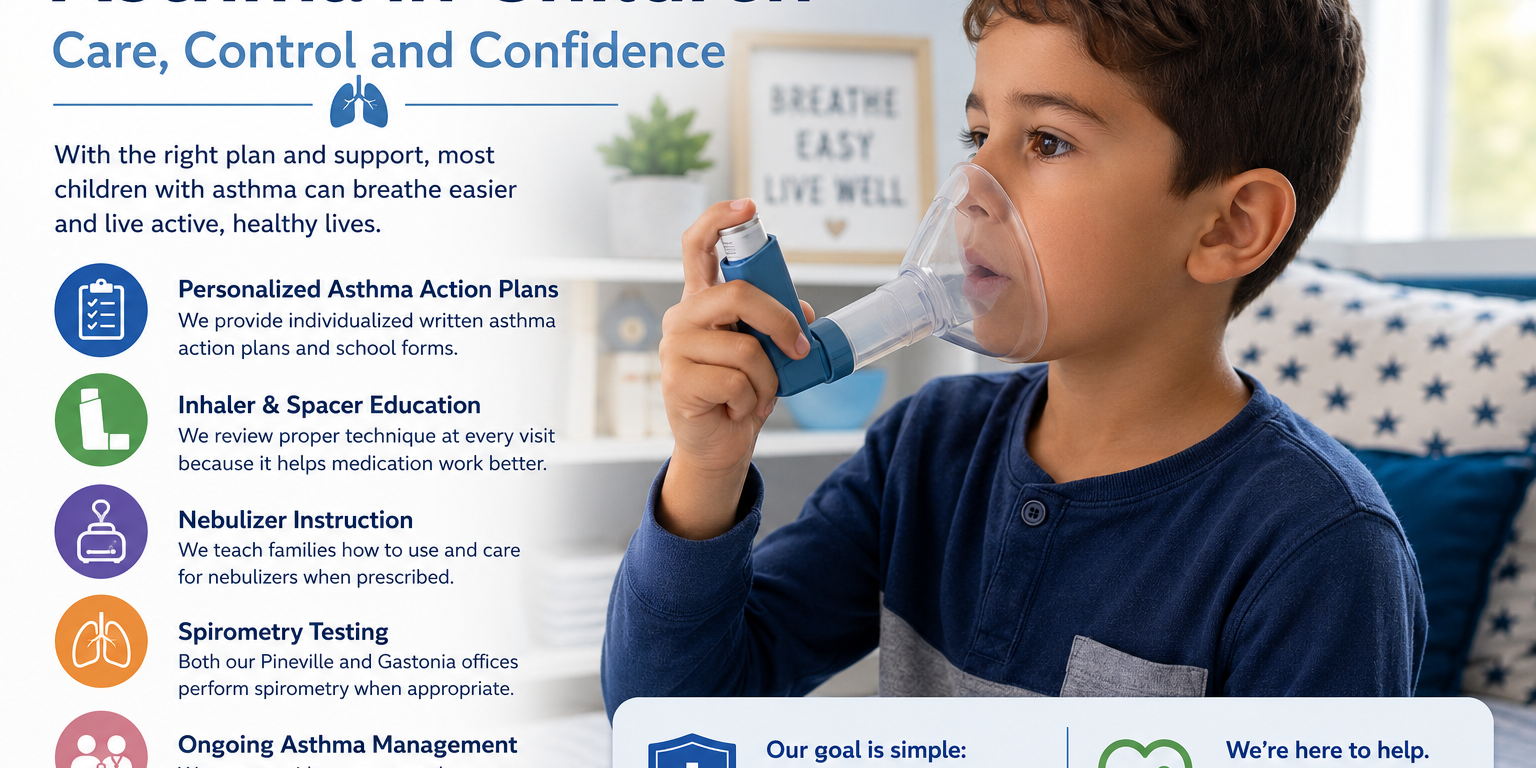
Using an Inhaler With a Spacer
Many children use a metered-dose inhaler with a spacer or holding chamber.
A spacer helps more medication reach the lungs instead of remaining in the mouth or throat. Younger children may use a spacer with a mask.
Correct technique is essential for the medication to work effectively. A child may not receive the intended dose if the inhaler or spacer is used improperly.
During office visits, we review proper inhaler and spacer technique with families. Parents and children may be asked to demonstrate how they use the equipment so the care team can identify and correct any problems.
Bring the child’s inhaler and spacer to asthma follow-up visits when possible.
How Do I Use a Nebulizer Correctly?
Some children are prescribed medication that is delivered through a nebulizer.
A nebulizer changes liquid medication into a fine mist that the child breathes through a mask or mouthpiece.
When nebulized medication is prescribed, our pediatric team provides instruction on proper nebulizer use. Families may be shown how to:
- Assemble the equipment
- Measure and place the medication correctly
- Position the mask or mouthpiece
- Keep the child seated upright during treatment
- Complete the full prescribed treatment
- Clean and store the equipment properly
Contact the pediatrician if you are unsure whether the nebulizer is working correctly or whether your child is receiving the full medication dose.
What Is an Asthma Action Plan?
An asthma action plan is a written set of individualized instructions for managing the child’s condition.
We routinely provide individualized written asthma action plans for children who require ongoing asthma management.
An asthma action plan commonly explains:
- Daily medications
- The child’s usual triggers
- How to recognize worsening symptoms
- When to use quick-relief medication
- When to contact the pediatrician
- When to seek urgent or emergency care
Many plans use green, yellow and red zones.
Green Zone
The child is doing well, breathing comfortably and participating normally in activities.
Yellow Zone
The child has symptoms such as coughing, wheezing, nighttime waking or reduced activity and should follow the plan’s instructions for worsening asthma.
Red Zone
The child is having severe symptoms or is not responding adequately to quick-relief treatment and needs urgent medical attention.
Parents should provide a copy of the asthma action plan to the child’s school, childcare provider, coaches and other regular caregivers.
Asthma Forms for School, Daycare and Sports
Children with asthma may need written authorization allowing medication to be stored or administered outside the home.
When needed, we complete school medication authorization forms and asthma action plans for:
- Daycare
- Preschool
- Elementary, middle or high school
- School field trips
- Sports teams
- Summer camps
- Other supervised activities
Families should make sure the school or organization has current medication, properly labeled equipment and an updated asthma action plan.
How Can Parents Reduce Asthma Triggers at Home?
The most useful steps depend on the child’s known triggers.
Possible measures include:
- Keeping the home and car smoke-free
- Avoiding vaping near the child
- Treating visible moisture or mold problems
- Washing bedding regularly
- Using dust-mite covers when recommended
- Controlling cockroaches and other pests
- Checking outdoor air-quality and pollen levels
- Keeping windows closed during high-pollen periods when appropriate
- Avoiding strong fragrances and aerosol sprays
- Using exhaust fans while cooking
- Following recommendations for pet exposure
- Encouraging handwashing and routine vaccinations
Families do not need to make every possible environmental change at once. The pediatrician can help identify which steps are most relevant to the individual child.
Can Children With Asthma Have Pets?
Sometimes.
Whether a pet affects a child’s asthma depends on whether the child is sensitive or allergic to that animal.
A pet should not automatically be removed from the home solely because a child has asthma. However, if symptoms repeatedly worsen around the animal, discuss the pattern with the pediatrician.
Possible recommendations may include:
- Keeping the pet out of the child’s bedroom
- Washing hands after contact
- Cleaning floors and upholstered surfaces
- Using a suitable air filter
- Allergy testing
- Considering more significant changes when exposure clearly causes serious symptoms
There is no truly hypoallergenic cat or dog.
Can Weather Affect Asthma?
Yes.
Asthma symptoms may worsen with:
- Cold air
- Sudden temperature changes
- Hot, humid weather
- Thunderstorms
- High pollen levels
- Wildfire smoke
- Poor outdoor air quality
On days when outdoor conditions are likely to trigger symptoms, families may need to limit prolonged exposure or follow instructions in the child’s asthma action plan.
Heat and poor air quality can be especially challenging for children with asthma.
Asthma at School
Asthma should be managed consistently at school as well as at home.
Parents should:
- Give the school a current asthma action plan
- Provide properly labeled medication and equipment
- Complete required medication authorization forms
- Confirm who is authorized to administer medication
- Tell the school nurse about recent attacks or medication changes
- Make sure teachers and coaches recognize the child’s symptoms
- Discuss whether the child is permitted to carry an inhaler
- Request appropriate support for physical education and field trips
Asthma is a common cause of missed school, but good control can help children participate more fully and reduce absences.
How Do I Know Whether My Child’s Asthma Is Controlled?
Asthma may not be well controlled when a child:
- Has frequent daytime symptoms
- Wakes at night because of coughing or breathing difficulty
- Uses quick-relief medication more often than recommended
- Avoids exercise or play
- Misses school because of symptoms
- Makes repeated urgent-care or emergency visits
- Needs repeated oral steroid treatment
- Cannot participate normally in everyday activities
Parents sometimes assume that frequent coughing or activity limitations are simply normal for a child with asthma. They are not necessarily normal and should be discussed with the pediatrician.
Why Are Regular Asthma Follow-Up Visits Important?
Asthma symptoms and medication needs can change as a child grows.
During follow-up visits, the pediatrician may review:
- Symptom frequency
- Nighttime waking
- Exercise tolerance
- Quick-relief medication use
- Emergency visits
- School absences
- Medication adherence
- Inhaler and spacer technique
- Nebulizer technique, when applicable
- Growth
- Medication side effects
- Changes in triggers
- Whether the asthma action plan needs updating
- Whether spirometry or additional testing is appropriate
Treatment may be increased when symptoms are poorly controlled or reduced when control has remained stable, depending on the child’s individual situation.
When Should I Call the Pediatrician?
Contact your child’s pediatrician when:
- Coughing or wheezing is becoming more frequent
- Symptoms are waking the child at night
- The child is avoiding exercise
- Quick-relief medication is needed more often than recommended in the asthma action plan
- The medication does not last as long as expected
- The child has repeated respiratory infections with wheezing
- The child has missed school because of symptoms
- You are unsure whether the inhaler, spacer or nebulizer is being used correctly
- The current asthma action plan is unclear or outdated
- Symptoms have changed significantly
Contact the office promptly for worsening symptoms even when they do not yet appear to be an emergency.
When Is Asthma an Emergency?
Seek emergency medical care when a child:
- Is struggling to breathe
- Cannot speak normally because of shortness of breath
- Has severe chest retractions, with the skin pulling inward around the ribs or neck
- Has blue, gray or very pale lips or skin
- Is unusually drowsy, confused or difficult to wake
- Is unable to walk or perform normal activity because of breathing difficulty
- Has symptoms that worsen quickly
- Does not improve after using quick-relief medication as directed
- Has peak-flow readings in the emergency zone when peak-flow monitoring is part of the child’s plan
Call 911 for severe breathing difficulty, blue or gray coloring, unresponsiveness or another life-threatening symptom.
Do not delay emergency care while waiting for a callback from the pediatrician.
Frequently Asked Questions About Asthma in Children
Can a child outgrow asthma?
Some children experience fewer symptoms as they grow, particularly those who wheezed mainly with viral infections during early childhood.
Other children continue to have asthma as adolescents or adults. It is difficult to predict with certainty whether an individual child will outgrow the condition.
Even when symptoms have been absent for a long time, they may return later.
Is asthma contagious?
No. Asthma cannot be passed from one person to another.
However, contagious respiratory infections can trigger asthma symptoms.
Is wheezing always asthma?
No. Wheezing can occur with viral infections and several other medical conditions.
Repeated wheezing, especially when associated with coughing, exercise, allergies or nighttime symptoms, should be evaluated by a healthcare provider.
Can a child have asthma without wheezing?
Yes. Some children mainly experience coughing, chest tightness or shortness of breath.
A nighttime cough or exercise-related cough may be an important clue.
Can asthma be cured?
There is currently no cure for asthma, but appropriate treatment can often control symptoms very effectively.
Many children with well-managed asthma participate fully in sports, school and daily activities.
Are inhaled steroids safe for children?
Inhaled corticosteroids are commonly used to control persistent asthma. Like all medications, they can have side effects, but the dose delivered to the body is generally much lower than with oral steroid medication.
The pediatrician will consider the lowest effective dose and monitor the child’s symptoms, growth and response to treatment.
Poorly controlled asthma also carries risks, so families should discuss concerns before stopping medication.
Should my child avoid sports?
Usually not.
With appropriate treatment, most children with asthma can take part in sports and exercise. Symptoms during activity should be discussed with the pediatrician rather than accepted as unavoidable.
Does my child need an asthma action plan?
Children who require ongoing asthma management should generally have an individualized written plan explaining daily treatment, worsening symptoms and emergency steps.
The plan should be shared with the school, daycare, coaches and other regular caregivers.
What is the difference between quick-relief medication and a rescue inhaler?
Quick-relief medication is the preferred medical terminology used in current asthma guidelines. “Rescue inhaler” is a commonly used term that many parents recognize.
Both terms generally refer to medication prescribed to relieve coughing, wheezing, chest tightness or shortness of breath when asthma symptoms occur.
When should my child see an asthma specialist?
A referral to a pediatric allergist or pulmonologist may be helpful when symptoms remain difficult to control, the diagnosis is uncertain, serious asthma attacks continue to occur or additional testing is needed.
Pediatric Asthma Care in Pineville and Gastonia
Both our Pineville and Gastonia pediatric offices evaluate, diagnose and provide ongoing management for children with asthma and recurrent wheezing.
Our pediatric team can help families with:
- Evaluation of coughing, wheezing and shortness of breath
- Asthma diagnosis
- Spirometry when age appropriate
- Trigger identification
- Inhaler and spacer education
- Nebulizer instruction
- Quick-relief and controller medication management
- Individualized written asthma action plans
- School and daycare medication authorization forms
- Sports asthma forms and action plans
- Asthma follow-up visits
- Coordination with pediatric allergists or pulmonologists when needed
Contact Ages & Stages Pediatric Group if your child has recurring coughing, wheezing, shortness of breath, nighttime symptoms or difficulty participating in normal activities.
About the Medical Reviewer
Eduardo Garrido Goico, MD, FAAP, is a board-certified pediatrician and co-founder of Ages & Stages Pediatric Group. He provides preventive, developmental, behavioral and general pediatric care for infants, children and adolescents.
Medical Disclaimer
This article is intended for general educational purposes only. It does not replace diagnosis, treatment or individualized medical advice from your child’s healthcare provider. Contact a qualified healthcare professional if you have concerns about your child’s breathing or asthma symptoms. Seek emergency care for severe breathing difficulty, blue or gray coloring, unresponsiveness or other life-threatening symptoms.
“`