
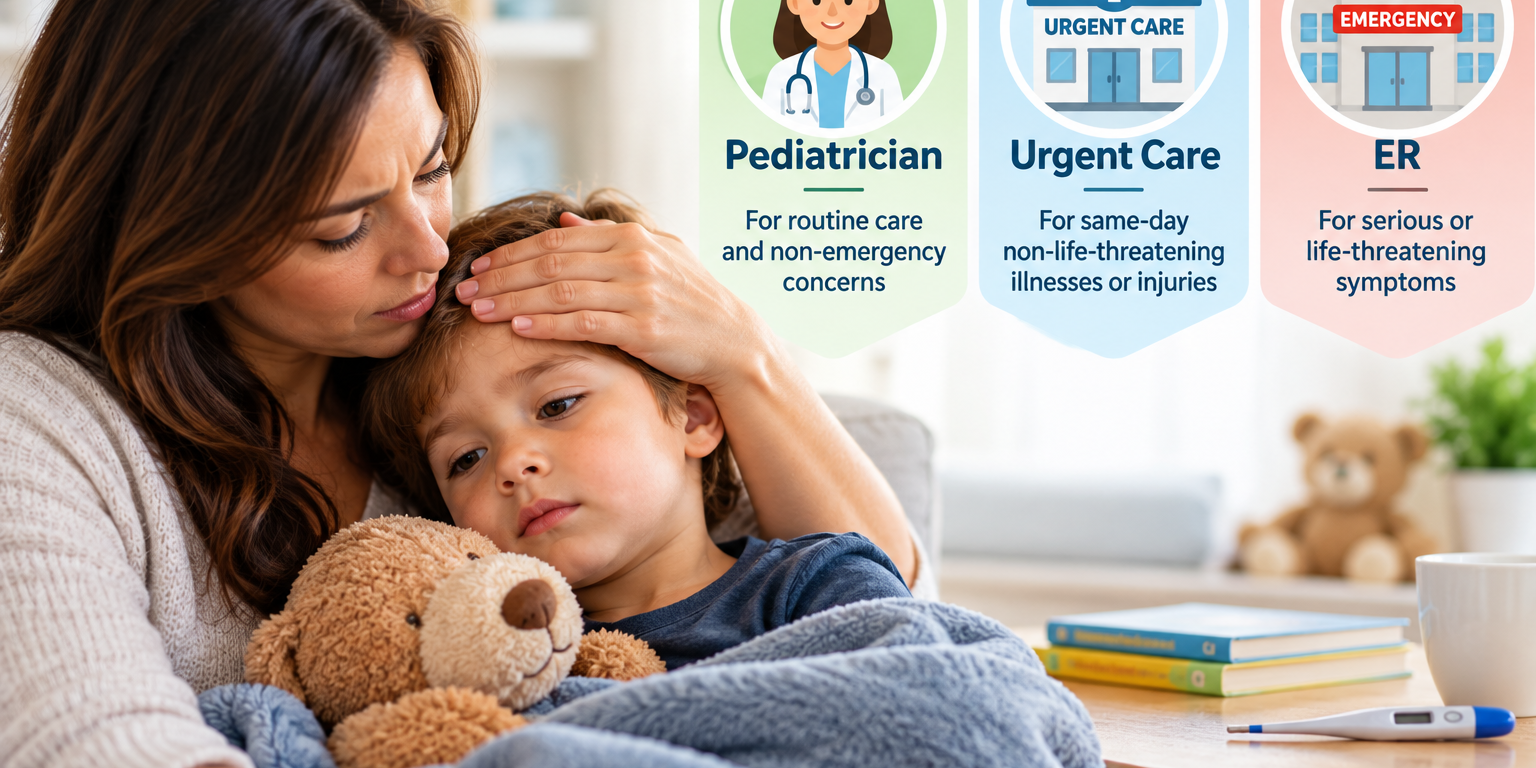
When your child is sick or injured, one of the hardest questions can be deciding where to go for care.
Should you call the pediatrician? Visit urgent care? Head straight to the emergency room?
The answer depends on your child’s symptoms, how quickly they need to be evaluated, and whether there are signs of a potentially serious or life-threatening problem.
For many illnesses and minor injuries, your child’s pediatrician is the best place to start. Urgent care can be useful when a problem needs same-day attention and your pediatrician is unavailable. The emergency room is appropriate when symptoms suggest that your child may need immediate or advanced emergency care.
When to Call Your Child’s Pediatrician
Your pediatrician is usually the best first call for illnesses or concerns that are not life-threatening.
Because your pediatrician knows your child’s medical history, medications, growth, development, and ongoing health concerns, the office can often help determine whether your child needs to be seen and how quickly.
You may want to contact your pediatrician for concerns such as:
- Fever without emergency warning signs
- Cold or flu-like symptoms
- Cough, congestion, or sore throat
- Ear pain
- Mild vomiting or diarrhea
- Minor rashes
- Possible pink eye
- Mild asthma symptoms that respond to your child’s prescribed treatment
- Questions about medications
- Ongoing headaches or stomachaches
- Behavioral, developmental, or school concerns
- Symptoms that are not improving as expected
Your pediatrician may recommend a same-day sick visit, a regularly scheduled appointment, home monitoring, or another level of care depending on your child’s symptoms.
When you are uncertain, calling the pediatrician first is often a good place to start.
When Urgent Care May Be Appropriate
Urgent care is designed for illnesses and injuries that need prompt evaluation but are not life-threatening emergencies.
It may be helpful when your pediatrician’s office is closed or when your child needs same-day care and an appointment is not available.
Examples may include:
- Ear pain or suspected ear infection
- Sore throat that may need testing
- Flu-like symptoms in a child who is breathing comfortably and staying hydrated
- Minor cuts that may need stitches or skin adhesive
- Sprains or other minor injuries
- Mild to moderate rashes without emergency symptoms
- Persistent vomiting or diarrhea when your child can still drink fluids
- Fever accompanied by symptoms that warrant same-day evaluation
Whenever possible, choosing an urgent care center experienced in treating children can be helpful.
Urgent care should not replace your child’s pediatrician for routine care, ongoing medical conditions, preventive visits, vaccinations, or long-term management.
When Should You Go to the Emergency Room?
The emergency room is appropriate when a child has symptoms that may be serious, rapidly worsening, or life-threatening.
Seek emergency care right away if your child has signs such as:
- Severe difficulty breathing
- Blue, gray, or unusually pale lips, face, or skin
- Skin pulling in between or underneath the ribs with each breath
- Loss of consciousness
- A child who is extremely difficult to wake or is not responding normally
- A seizure
- Severe chest pain, especially with fainting, dizziness, or difficulty breathing
- A serious head injury
- Severe bleeding that will not stop
- A suspected poisoning or overdose
- A serious burn
- A severe allergic reaction, particularly with difficulty breathing or swelling of the face or throat
- Sudden confusion or unusual behavior
- A stiff neck accompanied by fever and severe illness
- A rapidly developing purple or bruise-like rash that is not explained by an injury
- Signs of severe dehydration, such as very little or no urination, extreme sleepiness, dry mouth, or inability to keep fluids down
If you believe your child may be experiencing a life-threatening emergency, call 911.
What About Fever?
Fever is one of the most common reasons parents wonder where to seek care.
The temperature itself is only part of the picture. Your child’s age, behavior, breathing, hydration, and other symptoms are also important.
A baby younger than 3 months old with a temperature of 100.4°F (38°C) or higher needs prompt medical evaluation.
Parents should also seek medical advice when a child with fever:
- Looks very ill or unusually sleepy
- Is difficult to wake
- Has difficulty breathing
- Has repeated vomiting or cannot keep fluids down
- Has a stiff neck
- Develops an unexplained or concerning rash
- Has a seizure
- Appears dehydrated
- Has fever that continues longer than expected or improves and then returns
For many older children, a fever accompanied by mild cold symptoms, normal breathing, adequate fluid intake, and periods of normal activity can often be discussed with the pediatrician rather than automatically requiring an emergency room visit.
Pay Attention to Breathing, Alertness, and Hydration
When trying to decide how urgently your child needs care, three questions can be especially useful:
Is My Child Breathing Normally?
Difficulty breathing, unusually rapid breathing, struggling for each breath, or skin pulling in around the ribs should be taken seriously.
Is My Child Alert and Responding Normally?
A sick child may understandably be tired, but a child who is extremely difficult to wake, confused, unresponsive, or behaving very differently from normal needs urgent evaluation.
Is My Child Able to Drink and Stay Hydrated?
Watch for decreased urination, a very dry mouth, absence of tears when crying, repeated vomiting, or inability to drink.
Changes in any of these areas can be more important than a single temperature reading or symptom.
Your Pediatrician Can Help You Decide
Parents do not have to make every decision about medical care alone.
If your child is sick or hurt and the situation does not appear immediately life-threatening, contact your pediatrician. The care team can help you determine whether your child should:
- Be monitored at home
- Come to the pediatrician’s office
- Visit urgent care
- Go to the emergency room
Ages & Stages Pediatric Group offers pediatric care in Pineville and Gastonia, including same-day sick appointments when scheduling allows.
Calling earlier in the day may provide more same-day appointment options.
When in Doubt, Trust Your Concern
Parents know their children well. If something seems significantly different from your child’s usual behavior, symptoms are worsening quickly, or you are seriously concerned about your child’s condition, seek medical advice.
It is better to ask than to delay care when you are worried.
For non-emergency concerns, contact Ages & Stages Pediatric Group or request an appointment at the Pineville or Gastonia office.
For a life-threatening emergency, call 911 or go to the nearest emergency department.
Medically reviewed by Eduardo Garrido-Goico, MD, FAAP
Board-Certified Pediatrician and Co-Founder, Ages & Stages Pediatric Group
This article is intended for general educational purposes and should not replace individualized medical advice, diagnosis, or treatment. Recommendations may differ based on your child’s age, medical history, symptoms, and individual circumstances.





1 Comment